
Cognitive Writing: Writing for the Mind
A Framework for Educators to solve the writing proficiency crisis
• Professional Development Workshops for Educators
• Globally Recognized Author - OER Textbook on Cognitive Writing™ downloaded 200+ times in 44 countries within the first 30-days of publication
• 30+ Conference Presentations on Leadership & Systems Thinking
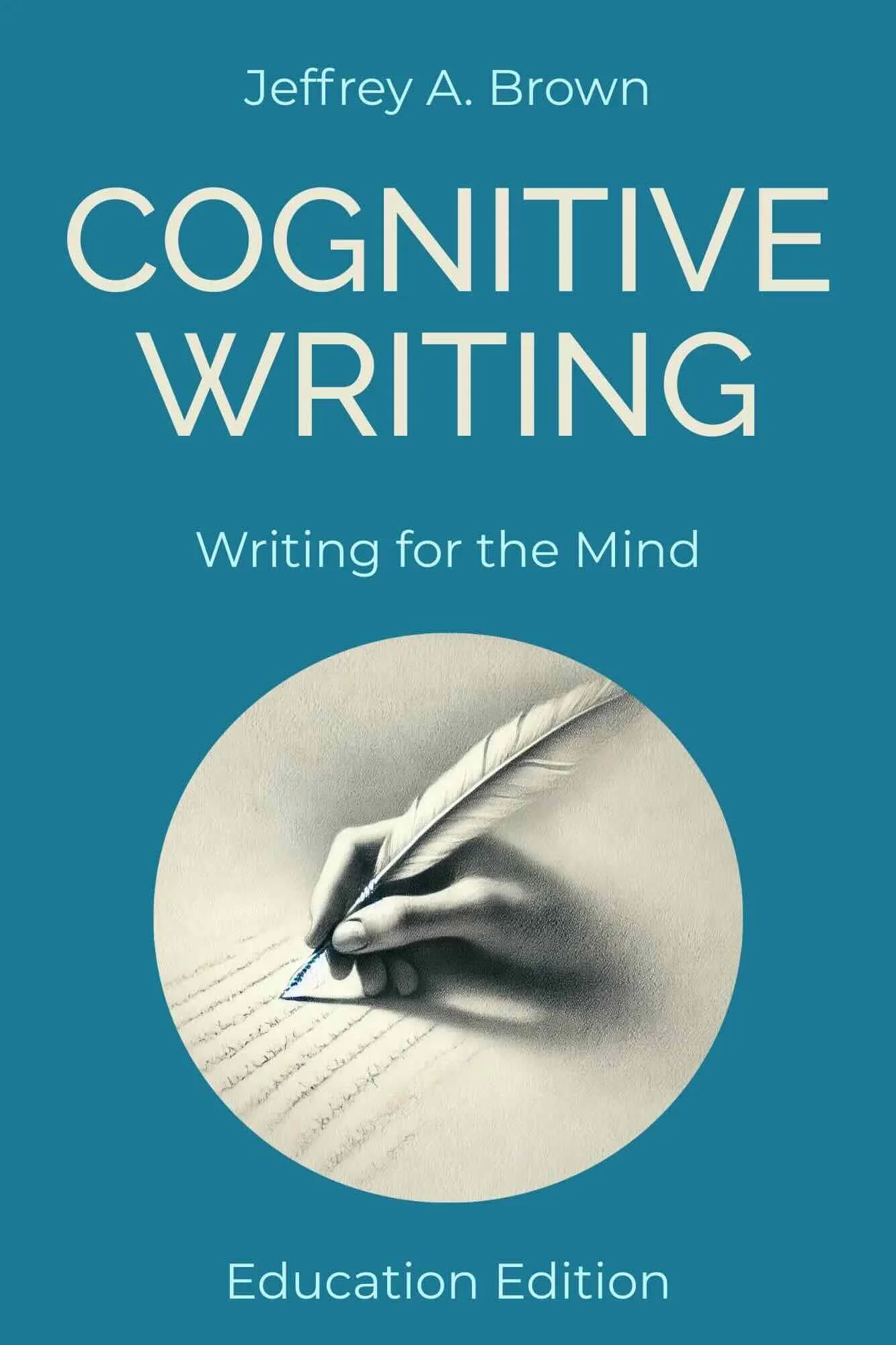
• Framework Developer - Cognitive Writing: Writing for the Mind
Jeffrey A. Brown brings a systematic, engineering-oriented approach to solving the writing proficiency crisis in our schools. As an Executive Coach and Mentor, he applies cognitive science and systems thinking to transform how we teach writing.
Despite having dysgraphia, a neurological condition that makes writing difficult, Jeffrey became a prominent author. Seeking understanding, he reverse-engineered his own writing to discover a framework that contradicted traditional writing instruction. This prompted him to share Cognitive Writing with educators across the globe.
The result: Cognitive Writing, a complete framework published as a 350-page textbook (downloadable via OER Commons and MERLOT) makes writing instruction objective, teachable, and accessible to students at any grade level. Currently, in use in classrooms from gifted K-8 schools to university writing programs, districts implementing multi-year proficiency improvement plans, and 2E educational researchers.
Jeffrey brings Cognitive Writing—the solution to a 50-year writing crisis.

This 60-90 minute interactive workshop transforms how educators are teaching writing.
Bring your team the Cognitive Writing™ experience—a complete system that makes writing as easy to implement as the scientific method. Walk away with objective standards, teachable techniques, and 25 ready-to-use examples your team can implement Monday morning.
Available for: School districts, individual schools, teacher conferences, university writing programs.
Workshop Fee: Contact for custom pricing
The crisis exists. The solution exists. Schedule your workshop today.
Learning Outcomes
Objective writing standards - Use the Cognitive Writing Checklist to evaluate student writing with measurable criteria
Identify cognitive transfer techniques - Recognize archetypes, strategic omission, thought voice, and sentence rhythm in any text
Replace subjective feedback - Learn to give students specific, actionable guidance to improve writing
Understand how minds reconstruct ideas - Explain why kindergarten-level vocabulary can create sophisticated impact
Implement Monday morning - Use the 25 example pieces and framework immediately in any grade level classroom


Cognitive Writing Techniques
The workshop focuses on four foundational techniques. Each addresses how readers reconstruct ideas from text—turning writing instruction into systematic practice.
Protagonist Fluidity
Understand how archetypes allow co-creation for the reader. "Mary had a little lamb" is recognized globally because readers create their own Mary. Teaching instructions that scale across any grade level.
Cognitive Ownership
Understand how readers’ ownership of characters create powerful emotions. When students learn to preserve reader ownership through strategic word choice, they create an emotionally unique reading experience.
Title Framing
Guide interpretation without controlling it. A single word can frame how readers process everything that follows. Students learn to use titles strategically—writing them last for maximum impact.
Thought Voice & Strategic Omission
Simple words create powerful impact. Learn how kindergarten-level vocabulary can bypass cognitive analysis. Strategic gaps allow readers to complete meaning themselves. Sophistication comes from precise use of simple words.
What to Expect:
Your team will experience Cognitive Writing firsthand.
An interactive demonstration reveals how cognitive transfer works. Through direct participation, discover the principles, experience them, then learn: the framework works on students of any grade level.
-
Participate in simple exercises that reveal how our mind processes writing.
Archetypal Learning: Remember the story “Mary had a little lamb.” Create a unique version of "Mary."
Cognitive Ownership: Experience ownership transfer through co-creation.
Title Framing: Experience how bias can guide interpretation.
Each demonstration teaches a core principle through experiential learning.
-
Somewhere along this journey, we begin to understand how writing is about transferring our idea to the reader—that single shift can change everything.
“This goes against everything I’ve ever been taught on how to instruct writing.”
— Career Teacher, Workshop Participant -
We will read and analyze a 217-word piece written at kindergarten level that creates profound emotional impact in adult readers.
The metadata reveals: Flesch-Kincaid Grade 0.2, Reading Ease 100.
This is the moment Cognitive Writing becomes clear—sophisticated simplicity through precise use of simple words.
-
The 350-page OER textbook offers 25 analyzed examples.
The Cognitive Writing Checklist provides objective standards.
A complete system ready for immediate curriculum implementation.
-
Downloadable OER textbook, scalable to any grade level, with clear implementation guidance.
Physical textbooks available for classroom use.





Still have questions? Take a look at the FAQ or reach out anytime. If you’re feeling ready, please register today for a workshop. Let’s solve the writing crisis in your school.
Your Questions, Answered-
Most writing programs are additive—adding strategies to traditional instruction. Cognitive Writing is replacement—a fundamentally different approach based on cognitive science rather than literary convention alone.
Three key differences:
1. Focus on the reader's mind and cognitive transfer
Cognitive Writing teaches systematic cognitive transfer—how to move ideas from one mind to another clearly and effectively.2. Objective standards through measurable techniques
The Cognitive Writing Checklist provides measurable techniques students can self-assess. Specific, teachable standards replace vague feedback.3. Universal scalability
The same framework works kindergarten through graduate level, globally, without cultural adaptation. "Mary had a little lamb" demonstrates this—it passes the Cognitive Writing framework perfectly.The result: A complete system that makes writing as teachable as the scientific method, accessible to every student through systematic technique.
-
Getting started is simple. Reach out through our contact form or schedule a call—we’ll walk you through the next steps and answer any questions along the way.
-
You can reach us anytime via our contact page or email. We aim to respond quickly—usually within one business day.
-
We offer flexible pricing based on project type and complexity. After an initial conversation, we’ll provide a transparent quote with no hidden costs.